RCS for Google Search to Conversation Journeys
A Complete Guide to Converting High-Intent Search Traffic into Conversations with RCS & AI Agents
The Shift from Clicks to Conversations
Search is no longer just about driving clicks to websites. It has evolved into a space where users expect immediate answers, real-time engagement, and guided decision-making. Instead of browsing through multiple pages or filling out forms, today’s customers want to act on their intent instantly. This shift is pushing businesses to rethink how they capture and convert search traffic.
Traditionally, search journeys have been fragmented. A user searches for something, clicks on a link, lands on a website, navigates through content, fills out a form, and then waits for a response. At every step, friction builds. Pages may load slowly, forms may feel tedious, and delayed follow-ups often lead to drop-offs. High-intent users, who were ready to take action, are frequently lost in this process.
This is where conversational experiences are changing the game. By integrating search with messaging, businesses can now move users directly from intent to interaction. Instead of redirecting users to a website, they can initiate a conversation instantly. This approach is faster, more intuitive, and significantly more aligned with modern user expectations.
Understanding RCS in the Context of Search
RCS, or Rich Communication Services, is often described as the next evolution of SMS, but in reality, it represents a fundamental upgrade in how messaging works. It transforms basic text messaging into a rich, interactive experience within the native messaging app on smartphones, particularly on Android devices.
Unlike SMS, which is limited to plain text, RCS enables businesses to deliver visually engaging and interactive messages. These can include images, videos, carousels, and actionable buttons that allow users to respond with a single tap. Businesses can also operate through verified sender profiles, which add a layer of trust and brand recognition to every interaction.
When combined with search, RCS becomes especially powerful. It allows businesses to engage users at the exact moment they express intent. Instead of waiting for users to navigate through a website, brands can initiate a structured, real-time conversation that guides users toward completing an action.
How Search-to-Conversation Journeys Work
The concept of search-to-conversation journeys is simple but transformative. A user begins with a high-intent search query, such as looking for a nearby service, applying for a financial product, or booking an appointment. These are moments where the user is not just exploring but is ready to act.
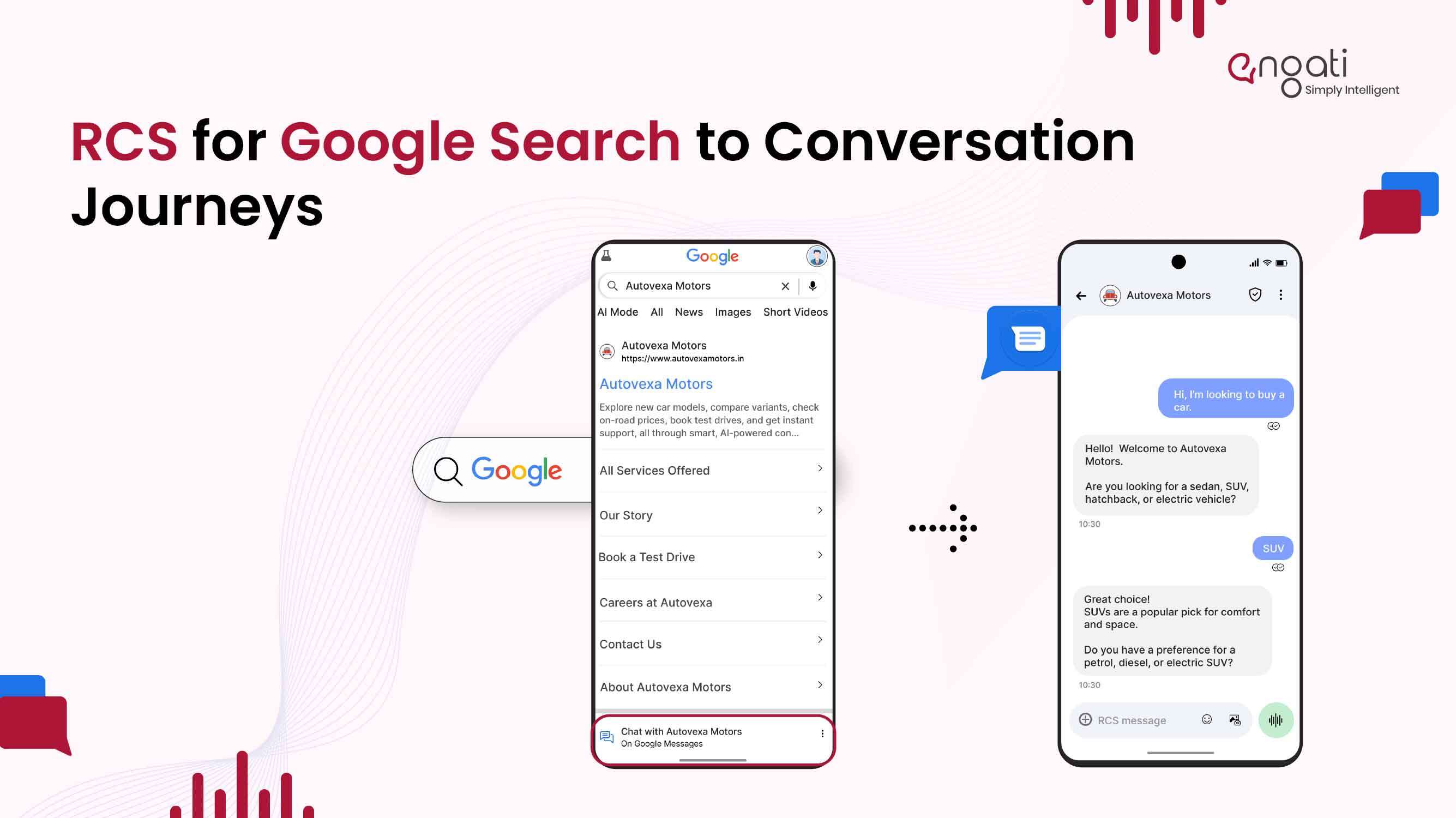
In an RCS-enabled environment, search results can include a messaging call-to-action, such as a “Message” or “Chat” option. When the user taps this, instead of being redirected to a website, they are taken directly into a messaging interface powered by RCS.
From there, an AI-driven agent takes over the interaction. The conversation begins instantly, often with a greeting and a set of guided options. The AI agent understands the user’s intent and continues the interaction by asking relevant questions, offering choices, and presenting recommendations. Because RCS supports structured interactions like buttons and quick replies, users can navigate the conversation effortlessly without typing long responses.
As the conversation progresses, users can complete meaningful actions within the same interface. This could include booking an appointment, checking eligibility for a service, scheduling a demo, or even making a purchase. The entire journey, from discovery to conversion, happens within a single conversational flow, eliminating the need for multiple steps.
Why RCS Drives Higher Conversion from Search
The effectiveness of RCS in search journeys comes down to timing, experience, and efficiency. Search intent is strongest at the exact moment a query is made. By capturing that intent immediately through a conversation, businesses reduce the risk of losing users to delays or distractions.
Another key advantage is the elimination of friction. Traditional journeys rely heavily on websites and forms, both of which introduce barriers. RCS removes these entirely, allowing users to move directly from intent to action without unnecessary steps. This creates a smoother and faster experience, which naturally leads to higher conversion rates.
Real-time engagement also plays a crucial role. With AI agents responding instantly, users are no longer left waiting. This immediacy not only improves user satisfaction but also keeps the momentum of the interaction intact. Additionally, conversational flows allow for better lead qualification. Instead of collecting static information through forms, businesses can dynamically ask questions, adapt based on responses, and route users more effectively.
Trust is another important factor. RCS supports verified business profiles, which reassure users that they are interacting with a legitimate brand. This credibility significantly improves engagement and response rates, especially in high-intent scenarios.
Where RCS Search Journeys Create Impact
The ability to convert search intent into conversations has practical applications across industries. In healthcare, for example, users searching for nearby hospitals or specialists can immediately start a conversation to book appointments or get preliminary guidance. In financial services, users can check loan eligibility or explore credit options without navigating complex websites.
In real estate, property discovery becomes more interactive, with users able to browse listings, ask questions, and schedule site visits within a conversation. E-commerce brands can guide users through product discovery and recommendations, while travel and hospitality businesses can assist with bookings and itinerary planning in real time.
What ties all these use cases together is the ability to reduce effort for the user while increasing efficiency for the business. Conversations replace static experiences, making interactions more intuitive and action-oriented.
Building a Strong RCS Search Strategy
To fully leverage RCS for search-to-conversation journeys, businesses need to align their strategy with user intent and behavior. It begins with identifying high-intent search queries, those that indicate a clear readiness to act. These often include phrases like “near me,” “best,” “apply,” or “book now,” and they present the strongest opportunities for conversion.
Equally important is the design of the conversation itself. Unlike traditional landing pages, conversational flows need to be structured yet flexible. They should guide users with clear options, minimize effort, and maintain a natural progression toward action. The role of AI here is critical, as it enables personalization at scale by adapting responses based on user input and context.
Integration with backend systems is another key component. For conversations to lead to actual conversions, they must connect seamlessly with CRM platforms, booking engines, and payment systems. This ensures that users can complete their journey without interruption.
Finally, optimization is an ongoing process. By analyzing metrics such as drop-off points, response times, and conversion rates, businesses can continuously refine their conversational flows to improve performance and maximize returns.
The Future of Search is Conversational
Search is steadily moving toward a more interactive and conversational model. As users become accustomed to instant responses and guided experiences, the expectation for seamless engagement will only grow stronger. Messaging platforms, powered by AI, are becoming central to this transformation.
RCS plays a crucial role in this shift by enabling rich, real-time interactions within a familiar environment—the native messaging inbox. It bridges the gap between discovery and action, allowing businesses to meet users where they are and guide them effortlessly toward outcomes.
Conclusion: From Intent to Action in One Flow
RCS for Google Search represents a fundamental shift in how businesses think about customer journeys. Instead of treating search as the starting point of a long funnel, it transforms it into a direct pathway to conversion.
By capturing intent instantly, engaging users in real time, and enabling action within a single conversation, businesses can create faster, more efficient, and more effective experiences. The result is not just improved conversion rates, but a more intuitive and satisfying journey for the user.
For organizations focused on growth and customer experience, search-to-conversation strategies powered by RCS and AI agents are quickly becoming a competitive necessity rather than an optional innovation.
.jpg)