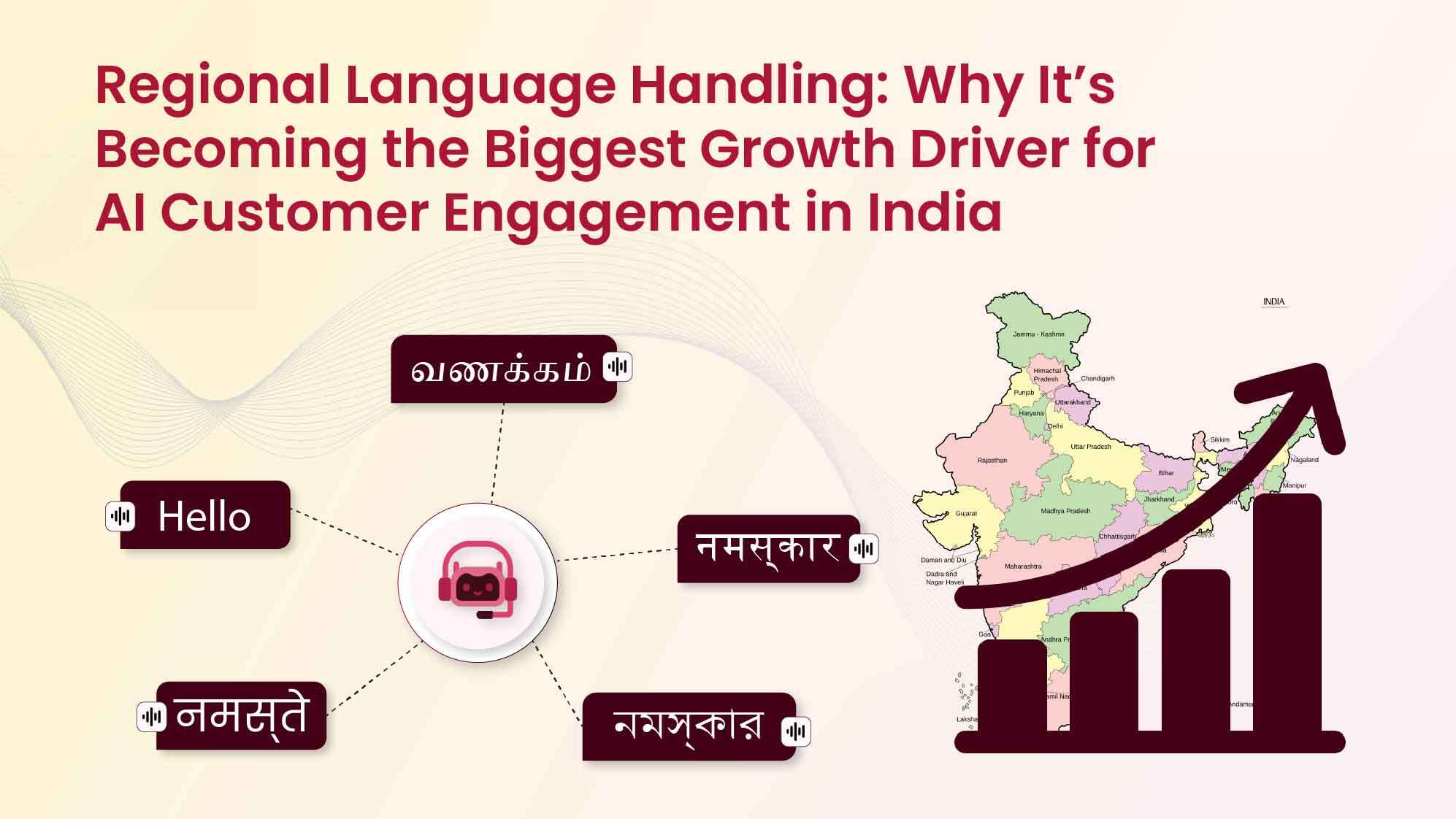
Regional Language Handling: Why It’s Becoming the Biggest Growth Driver for AI Customer Engagement in India
India’s digital economy is growing at an extraordinary pace, but one of the biggest shifts happening beneath the surface is not just about internet access or smartphone adoption. It’s about language.
For years, most digital customer experiences in India were designed primarily around English-speaking users. Websites, chatbots, customer support systems, apps, and automated workflows largely assumed that customers would type, read, and interact comfortably in English.
But the reality of India’s internet growth tells a very different story.
The next wave of digital users in India is overwhelmingly regional. Millions of consumers across Tier 2 and Tier 3 cities are coming online every year, and many of them are far more comfortable communicating in Hindi, Tamil, Telugu, Kannada, Malayalam, Marathi, Bengali, Gujarati, Punjabi, and other regional languages than in English.
In many cases, users may search in English, speak in Hinglish, and expect support in their native language, all within the same journey.
This shift is fundamentally changing how businesses think about customer engagement.
Regional language handling is no longer just a localization feature. It is becoming one of the most important factors influencing customer acquisition, support efficiency, engagement quality, and conversion rates across India.
India’s Internet Growth Is Being Driven by Regional Language Users
India is one of the most linguistically diverse countries in the world, with hundreds of spoken languages and more than 20 officially recognized regional languages. While English continues to dominate corporate communication, regional languages dominate everyday conversations for a massive percentage of the population.
This becomes especially important in digital interactions because language directly impacts trust, comfort, and accessibility.
A user may hesitate to fill out a financial application in English but feel completely comfortable discussing the same topic conversationally in Hindi or Tamil. A patient may better understand healthcare instructions in Kannada. A first-time internet user may prefer voice-based interactions in Telugu rather than navigating English-heavy interfaces.
This is one of the biggest reasons voice search, conversational AI, and multilingual engagement platforms are growing rapidly across India.
Users increasingly expect businesses to communicate in the language they naturally use, not the language the platform prefers.
What Regional Language Handling Actually Means
Many businesses assume multilingual support simply means translation. In reality, effective regional language handling is far more complex.
India’s conversational behavior is highly dynamic. Customers frequently:
- Switch between languages mid-sentence
- Use Hinglish or mixed-language conversations
- Speak with regional accents and dialects
- Use colloquial phrases instead of formal language
- Prefer voice interactions over typing
For example:
- “Kal morning appointment book karna hai.”
- “Delivery update Tamil la sollunga.”
- “EMI payment due date kya hai?”
Traditional chatbots and IVRs struggle with these patterns because they rely on rigid inputs and structured workflows.
Modern conversational AI systems, however, are designed to interpret contextual and mixed-language communication naturally.
This is where advanced regional language handling becomes critical.
AI systems today use technologies such as:
- Natural Language Processing (NLP)
- Automatic Speech Recognition (ASR)
- Large Language Models (LLMs)
- Conversational AI orchestration
- Speech synthesis and voice AI
These technologies help businesses understand not just language, but intent, context, and conversational flow across multilingual interactions.
Why Regional Language AI Performs Better in India
The reason regional language engagement performs so effectively is simple: people communicate more naturally in familiar languages.
When businesses remove language friction:
- Customers engage more confidently
- Support conversations become faster
- Conversion rates improve
- Drop-offs reduce significantly
- Customer trust increases
This is especially important in high-intent industries where clarity and confidence directly influence decision-making.
In healthcare, patients are more likely to book consultations and follow instructions when conversations happen in their preferred language.
In banking and financial services, multilingual support helps simplify onboarding, payment assistance, and customer education.
In retail and eCommerce, regional language engagement improves product discovery and post-purchase support.
Even sectors like edtech, telecom, insurance, and government services are rapidly adopting multilingual AI systems because regional accessibility directly impacts adoption and retention.
The impact goes beyond convenience. It expands market reach.
Businesses that support regional languages effectively are able to engage audiences that traditional English-first systems often fail to convert.
The Rise of Voice AI and Regional Language Search
One of the biggest accelerators behind regional language handling is the growth of voice-first behavior in India.
For many users, speaking is easier than typing. This is particularly true in mobile-first environments where users rely heavily on voice search and conversational interactions.
Search patterns are becoming increasingly natural and conversational:
- “Doctor appointment near me in Hindi”
- “Tamil customer support number”
- “Loan EMI details Hindi mein”
- “Order status check Kannada”
This shift is pushing businesses toward conversational AI systems capable of handling regional languages in real time.
Voice AI platforms can now:
- Understand Hindi and Hinglish conversations
- Support Tamil, Telugu, Kannada, and Malayalam voice interactions
- Detect language preferences automatically
- Respond conversationally across multiple languages
- Handle customer support end-to-end through voice automation
This creates more accessible and intuitive customer experiences, especially for users who may not be comfortable navigating text-heavy interfaces.
Why Traditional IVRs and Static Chatbots Fail
Traditional customer support systems were built around structured navigation, not natural conversation.
Customers were expected to:
- Press menu options
- Follow rigid flows
- Use predefined commands
- Communicate in limited languages
But real-world customer behavior doesn’t work that way, especially in India’s multilingual environment.
A customer may begin speaking in Hindi, switch to English terms for technical concepts, and use regional slang naturally within the same conversation.
Static systems struggle because they cannot adapt contextually.
Modern conversational AI platforms, however, are designed to interpret these patterns dynamically. Instead of forcing users into predefined structures, they allow conversations to happen naturally while still extracting accurate intent.
This is what makes advanced regional language handling such a critical differentiator for businesses scaling across India.
How Engati Enables Regional Language AI at Scale
Platforms like Engati are helping businesses deploy multilingual conversational AI across voice, WhatsApp, RCS, web, and customer support channels.
These systems allow organizations to:
- Automate customer conversations in regional languages
- Support multilingual voice and chat interactions
- Handle mixed-language conversations naturally
- Integrate AI with CRMs and backend systems
- Scale support operations without proportionally increasing human teams
Instead of offering language support as an isolated feature, businesses can create fully connected conversational journeys across customer touchpoints.
This becomes especially powerful in India, where language personalization directly influences engagement and conversion outcomes.
The Future of Customer Experience in India Is Multilingual
India’s digital growth story will not be driven by English-first experiences alone.
The next phase of customer engagement will be built around accessibility, conversational interaction, and regional relevance.
Businesses that continue relying solely on English-centric workflows risk excluding a massive and rapidly growing audience.
Regional language handling is no longer optional for companies scaling in India. It is becoming foundational to customer experience strategy.
As conversational AI, voice search, and multilingual automation continue evolving, businesses that can engage customers naturally across languages will gain a major competitive advantage in acquisition, support, and retention.
Because ultimately, customers don’t think in workflows or system architecture.
They think in the language they are most comfortable speaking.
And the businesses that understand that will be the ones that scale fastest in India’s multilingual digital economy.
To explore how this can be implemented for your business book a demo.
.jpg)