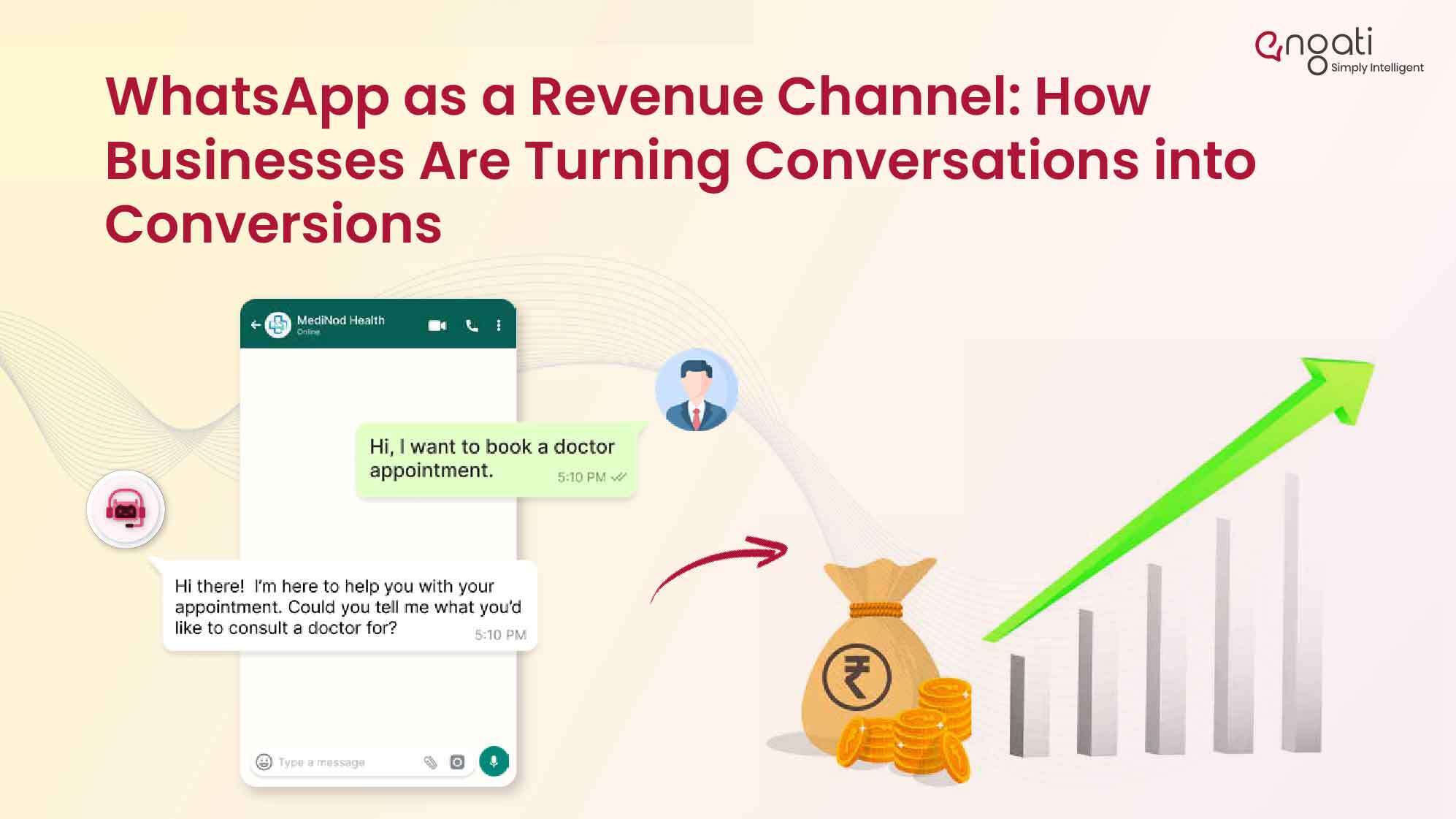
For years, businesses viewed WhatsApp primarily as a customer communication tool, a faster alternative to email or SMS support. But that perception is changing rapidly.
Today, WhatsApp is evolving into something far more valuable: a full-scale revenue channel.
Across industries such as retail, healthcare, banking, education, real estate, and eCommerce, businesses are increasingly using WhatsApp not just to respond to customers, but to actively drive acquisition, engagement, conversions, retention, and repeat purchases. The platform is no longer limited to customer support. It is becoming one of the most effective conversational commerce ecosystems in the digital economy.
This shift is happening because customer behavior itself has changed. Users no longer want fragmented journeys where they discover products on one platform, fill forms on another, wait for callbacks, and complete purchases elsewhere. They expect interactions to happen instantly, conversationally, and within the channels they already use daily.
And few platforms are as deeply integrated into daily communication habits as WhatsApp.
Why WhatsApp is Becoming a High-Conversion Business Channel
WhatsApp has fundamentally different engagement behavior compared to traditional digital channels.
Emails often go unread. SMS interactions are transactional and limited. Websites require navigation and effort. But WhatsApp conversations feel immediate, personal, and interactive.
Customers already use the platform daily to communicate with friends, family, and businesses. This familiarity reduces friction significantly during customer journeys.
For businesses, this creates several major advantages:
- Faster customer response rates
- Higher engagement levels
- Real-time conversational interaction
- Better retention and re-engagement
- Reduced drop-offs during purchase journeys
Most importantly, WhatsApp allows businesses to continue conversations instead of restarting journeys repeatedly.
A customer discovering a product through an ad can immediately start a conversation. That conversation can continue through product discovery, support, payment assistance, reminders, and post-purchase engagement, all within the same thread.
This continuity is one of the biggest reasons WhatsApp is emerging as a revenue-driving platform rather than just a communication tool.
The Rise of Conversational Commerce
Traditional digital funnels are becoming increasingly inefficient.
The older flow looked like this:
Search → Website → Form Fill → Callback → Conversion
Modern customers expect:
Discovery → Conversation → Instant Action
This behavioral shift has accelerated the rise of conversational commerce, where buying journeys happen through real-time messaging interactions instead of static workflows.
On WhatsApp, businesses can now:
- Recommend products conversationally
- Answer customer questions instantly
- Recover abandoned carts
- Schedule appointments
- Send payment reminders
- Automate follow-ups
- Share catalogs and offers
- Process support requests
- Re-engage inactive users
The conversation itself becomes the conversion journey.
This is particularly powerful because users do not feel like they are entering a “sales funnel.” The experience feels natural, immediate, and low-friction.
Why WhatsApp Outperforms Traditional Engagement Channels
One of WhatsApp’s biggest strengths is intent capture.
Customers often reach out at moments of high interest:
- After clicking an ad
- While exploring a product
- During purchase consideration
- While seeking support
- When comparing providers
In these moments, delayed engagement causes drop-offs quickly.
Traditional workflows struggle because they rely on:
- Static forms
- Delayed responses
- Email follow-ups
- Call center dependency
- Multi-step navigation
WhatsApp reduces these barriers by enabling real-time conversations directly inside the customer’s preferred communication channel.
Businesses using WhatsApp effectively often see:
- Higher response rates
- Better lead qualification
- Faster conversion cycles
- Improved customer retention
- Increased repeat purchases
Because the interaction happens conversationally, businesses can guide users through decision-making naturally instead of forcing them through rigid workflows.
AI and Automation Are Expanding WhatsApp’s Revenue Potential
The real transformation began when businesses started combining WhatsApp with conversational AI and automation.
AI-powered systems can now manage large-scale customer interactions on WhatsApp while maintaining personalized, conversational experiences.
Using technologies such as:
- Conversational AI
- Natural Language Processing (NLP)
- Workflow automation
- CRM integrations
- Voice AI integration
- Large Language Models (LLMs)
Businesses can automate complete customer journeys across acquisition, support, and retention workflows.
For example, AI systems can:
- Qualify leads automatically
- Recommend products dynamically
- Handle multilingual conversations
- Send proactive reminders
- Recover abandoned journeys
- Schedule appointments instantly
- Escalate high-intent customers to human agents
Instead of functioning like simple chatbots, modern AI systems act as intelligent engagement engines capable of driving measurable business outcomes.
Industry Use Cases: How Businesses Generate Revenue Through WhatsApp
The adoption of WhatsApp as a revenue channel is growing rapidly across industries.
Retail & eCommerce
Brands use WhatsApp for:
- Conversational product discovery
- Personalized recommendations
- Cart recovery workflows
- Order updates and support
- Loyalty and re-engagement campaigns
This improves both conversions and repeat purchases.
Healthcare
Hospitals and clinics use WhatsApp for:
- Appointment booking
- Consultation reminders
- Patient follow-ups
- Health campaign engagement
This reduces no-shows and improves patient acquisition.
Banking & Financial Services
Financial institutions automate:
- Loan inquiry workflows
- EMI reminders
- Customer onboarding
- Personalized financial engagement
This improves lead conversion while reducing operational overhead.
Real Estate
Property businesses use WhatsApp for:
- Lead qualification
- Site visit scheduling
- Automated follow-ups
- Buyer engagement journeys
This shortens sales cycles and improves lead nurturing efficiency.
EdTech
Educational institutions use WhatsApp for:
- Student counseling
- Enrollment assistance
- Application tracking
- Course recommendations
This creates more accessible and responsive student engagement.
Why WhatsApp Works Especially Well in India and Emerging Markets
In mobile-first markets like India, WhatsApp plays an even larger role in customer engagement.
Many users are more comfortable with conversational interactions than traditional website-based journeys. Regional language communication, voice notes, multimedia sharing, and instant messaging behavior make WhatsApp naturally suited for conversational commerce.
Businesses can engage users in:
- Hindi
- Tamil
- Telugu
- Kannada
- Malayalam
- Marathi
- Hinglish and mixed-language conversations, and more.
This significantly improves accessibility and customer comfort.
As digital adoption grows across Tier 2 and Tier 3 markets, conversational engagement through WhatsApp is becoming one of the most effective ways to scale customer acquisition and support.
The Shift from Support Channel to Revenue Infrastructure
The biggest change businesses are realizing is this:
WhatsApp is no longer just a support channel operating after the sale.
It is becoming infrastructure for:
- Customer acquisition
- Lead nurturing
- Conversion optimization
- Customer retention
- Repeat engagement
- Revenue expansion
The businesses seeing the strongest results are not using WhatsApp reactively. They are building proactive conversational journeys designed around customer intent and real-time engagement.
Instead of sending isolated campaigns, they are creating ongoing conversational ecosystems.
How Engati Helps Businesses Turn WhatsApp into a Revenue Engine
Platforms like Engati help businesses build AI-powered conversational experiences across WhatsApp, voice, RCS, web, and customer engagement channels.
Using conversational AI and workflow automation, businesses can:
- Automate customer journeys end-to-end
- Engage leads instantly
- Reduce response times
- Support multilingual interactions
- Scale customer engagement efficiently
- Improve conversion rates across channels
This enables organizations to transform WhatsApp from a messaging platform into a measurable growth and revenue channel.
The Future of Commerce is Conversational
Customer journeys are becoming increasingly conversation-driven. Users expect businesses to engage instantly, respond naturally, and reduce friction at every step.
WhatsApp sits at the center of this transformation because it combines familiarity, accessibility, speed, and conversational interaction in a single platform.
Businesses that treat WhatsApp as just another communication tool will likely underutilize its potential.
But businesses that treat it as a revenue channel—powered by conversational AI, automation, and personalized engagement—will be positioned to capture customer intent faster and convert conversations into measurable business growth.
With solutions from Engati, WhatsApp is evolving from a support interface into one of the most powerful conversational revenue channels in modern customer engagement. To explore book a demo.
.jpg)